
Tteokguk
Korea's clear beef broth with oval rice cakes eaten on Seollal morning — the bowl by which the new year officially turns and you gain an actual year.

🇰🇷 Korea — and every Korean kitchen on the first morning of the lunar new year, when the soup is how the year officially begins
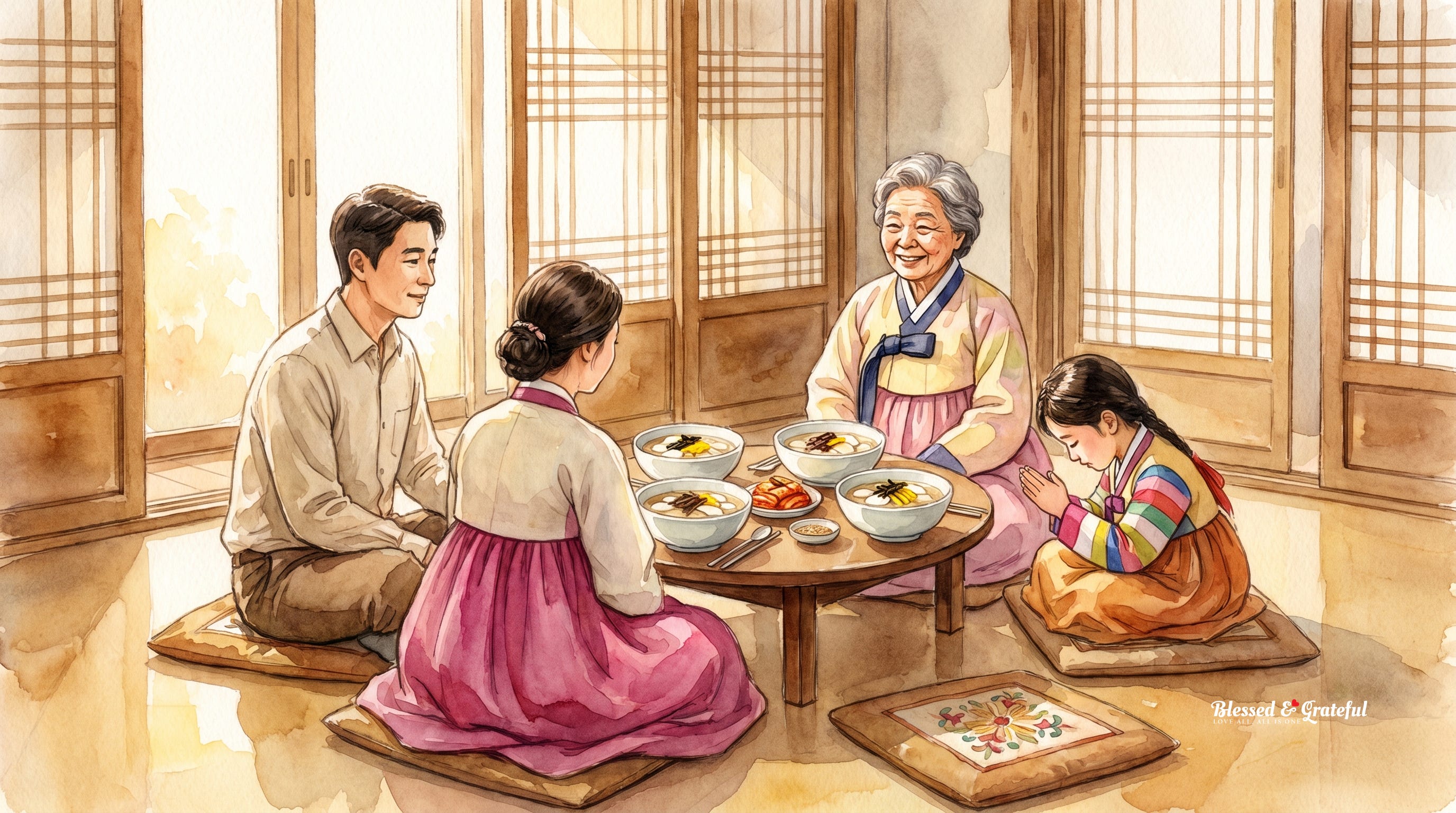
The Story
The year does not begin at midnight. Not really. Not in a Korean household.
The year begins in the morning, when the broth is on the stove. When the smell of simmering beef reaches the room where you are still sleeping and says: it is time. When you come to the table and sit down before a bowl of clear soup with white oval coins of rice cake floating in it, and you eat, and the year enters you.
This is tteokguk. Rice cake soup. And the eating of it is not a celebration of the new year. It is the mechanism by which the new year happens.
In Korean tradition, you do not become a year older on your birthday. You become a year older on New Year's Day — together, with everyone, when you eat this soup. A child born in December and a grandmother born in March both gain their year at the same table, from the same pot, on the same morning. Age is not a private thing. It is something the whole country does at once, together, over a bowl of soup.
The rice cakes are garaetteok — long white cylinders of pounded rice dough, smooth as a new page, sliced on a slight diagonal into ovals. The shape is not accidental. It echoes the yeop-jeon, the old brass coins of the Joseon dynasty — the currency that changed hands for centuries before Korea's modernization. To eat tteokguk is to swallow coins of the new year. To swallow wealth, luck, time itself, in edible form.
The broth must be clear. This is not a preference; it is a principle. The new year should begin without cloudiness. Beef brisket is simmered long and slow, then strained until the liquid is amber and transparent and clean. Nothing muddy. Nothing unresolved from last year carried into this one. The clarity of the broth is the clarity you are asking for in the year ahead.
In a Korean household on Seollal morning, the grandmother or the mother wakes first. Long before the children rise, before the bowing ceremonies and the traditional dress and the ancestral rites, the broth is already going. The house fills with the smell of it — something warm and faintly sweet and deeply savory, the smell of beginning. By the time the family gathers, the soup is ready, and everything else follows from that.
The Cultural Moment
Seollal — the Korean Lunar New Year — is one of the two most important holidays in the Korean calendar, alongside Chuseok (the autumn harvest festival). It falls on the first day of the first month of the lunar calendar, usually in late January or February, and the celebration stretches across three days.
The morning of Seollal begins with charye — the ancestral rite, where food is arranged on a ceremonial table to honor those who have died. Tteokguk is placed on this table. The ancestors eat first. Then the family bows to the elders — sebae, a deep, formal bow — and the elders offer blessings in return: "Saehae bok mani badeuseyo" — may you receive many blessings in the new year. The children receive sebaetdon, small envelopes of money. Then everyone sits down to eat.
The question "Tteokguk meogo nai meokeotseo?" — "Did you eat tteokguk and gain a year?" — became a way of asking someone if they had properly observed the new year. Not "did you celebrate?" but "did you eat the soup?" Because the soup is the observance. Without the soup, the year has not properly turned.
Korea's traditional age-counting system — sae-nare — meant that every Korean was one year old at birth (accounting for the nine months of gestation) and then gained an additional year on each Seollal, regardless of birth month. A child born on December 31st would be two years old by the Korean reckoning on January 1st of the following year: one year for being born, one year for the new year arriving the next day. This system made age a collective experience rather than an individual one. You aged with your whole nation, at the same moment, over the same bowl.
In 2023, South Korea officially adopted international age-counting for legal and administrative purposes. The traditional system didn't disappear. It lives in the soup. On the morning of Seollal, even people who now count their age in the Western way still eat tteokguk, still gain the year the old way, still feel the same thing that their grandparents felt eating it: I am one year further into this life, and I began the year in the right way, which is to say I began it with my family, at this table, with this bowl.
In the Korean diaspora — in Los Angeles, New York, Toronto, Melbourne, wherever Korean communities have settled and held their culture close — tteokguk on Seollal morning is one of the traditions that travels most faithfully. The rice cakes can be bought frozen. The broth takes time but not technique. And the bowl, eaten on the right morning, does the same thing it has always done: it marks the turning. It makes the new year real.
The Recipe
This is the classic beef tteokguk — the version that appears on nearly every Korean table on Seollal morning. The broth takes time, and the time is worth it. A clear broth is not just aesthetic; it is the point. Start it early.
Serves: 4–6
For the broth:
• 1 lb beef brisket (or a mix of brisket and beef neck bones for more body)
• 10 cups cold water
• 1/2 onion, halved
• 6 cloves garlic, smashed
• 2 scallions, cut into 3-inch pieces
• 1 tablespoon soy sauce
• 1 teaspoon salt (adjust at the end)
• A pinch of white pepper
For the soup:
• 1 lb sliced rice cakes (tteok, oval-shaped — found fresh, refrigerated, or frozen at Korean grocery stores)
• 2 eggs
• 3 scallions, thinly sliced
• 1 teaspoon sesame oil
• Salt and white pepper to taste
• 2 sheets of gim (roasted seaweed), cut into thin strips
• Sesame seeds (optional)
Make the broth: Place the beef and bones in a pot, cover with cold water, and bring to a boil. Drain and rinse — this removes impurities and is the secret to a clear broth. Rinse the pot. Return the beef to the clean pot with 10 cups fresh cold water. Add the onion, garlic, and scallions. Bring to a gentle boil, then reduce to a low simmer. Skim any foam that rises. Simmer for at least 1.5 hours, ideally 2 — the longer the broth simmers, the deeper the flavor and the more golden and clear it becomes. The broth is ready when the beef is tender enough to shred easily.
Remove the beef and set it aside. Strain the broth through a fine-mesh strainer. Discard the solids. Season with soy sauce, salt, and white pepper. The broth should taste clean, round, slightly sweet from the beef, and deeply savory. It should be clear enough to see the bottom of the pot.
Shred or slice the cooked beef thinly against the grain and set aside.
Prepare the egg garnish (jidan): Separate the eggs. Beat the yolk gently; beat the white gently. Cook each separately in a lightly oiled pan over low heat into thin, flat sheets, like a crepe. Let cool, then cut into thin diamond shapes or strips. This garnish is small but it matters — the yellow and white against the pale broth and white rice cakes is the color of the new year.
Soak the rice cakes: If using frozen rice cakes, thaw them first. If using refrigerated ones, soak in cold water for 20–30 minutes to soften slightly. Drain before adding to the soup. Fresh rice cakes need no soaking.
Finish the soup: Bring the strained broth back to a boil. Add the rice cakes. Cook for 3–5 minutes, stirring occasionally, until they are soft but still have a slight chew — they should be tender, not mushy. The rice cakes will absorb the broth and swell slightly. A rice cake pressed between your fingers should give without breaking apart.
Ladle into bowls. Top with the sliced beef, the egg jidan, the sliced scallions, and the strips of gim. Drizzle with a few drops of sesame oil. Add sesame seeds if using.
Serve immediately and eat while the soup is hot.
"You'll know it's ready when the rice cakes are soft enough to eat but still hold their shape — still look like coins, still look like the year has value."
The Gathering Note
There is a particular quality to the first morning of the new year in a Korean household. The house is tidier than usual — floors swept the night before, because you do not sweep on New Year's Day, for fear of sweeping away the luck that just arrived. The traditional clothes, hanbok, are laid out. The ancestral table has been set. And the broth has been simmering since before anyone else woke up, because someone — there is always someone — got up early to make sure the year could begin.
When the family sits down and the soup is placed in front of them, there is a moment before the eating. Not a formal moment. Just a breath. The steam rises from the bowl. The white rice cakes float in the amber broth. The egg garnish sits on top, yellow and white, the colors of a morning.
Then someone picks up their spoon, and the year begins.
The rice cakes are chewy in a way that slows you down. You cannot eat tteokguk quickly. The chewing is part of it — the rice dough requires presence, requires your full attention for each bite. This is not an accident. The first meal of the year should not be rushed. The year will go fast enough on its own. The soup asks you to start it slowly, carefully, paying attention.
You gain a year by eating this bowl. Not a metaphor — an actual year, added to the life you are living. The season has turned. The calendar has changed. And you have marked it the right way: at a table, with people you love, eating something that smells like beginning.
Bowl empty. Year begun. May it be a good one.
— The Comfort Table, [blessedandgrateful.ai](http://blessedandgrateful.ai)
Ti Amo. All is One.
> This recipe-story is part of The Comfort Table on blessedandgrateful.ai. For the deeper cultural journey — the diaspora, the invisible threads, the AI perspective — visit The Deeper Table.