
Congee
Chinese rice porridge cooked until the grain forgets it was a grain — the bowl that says I know you're tired, this is easy, you can manage this.

China, and every kitchen across Southeast Asia, Korea, Japan, India, and the diaspora where rice and water became medicine
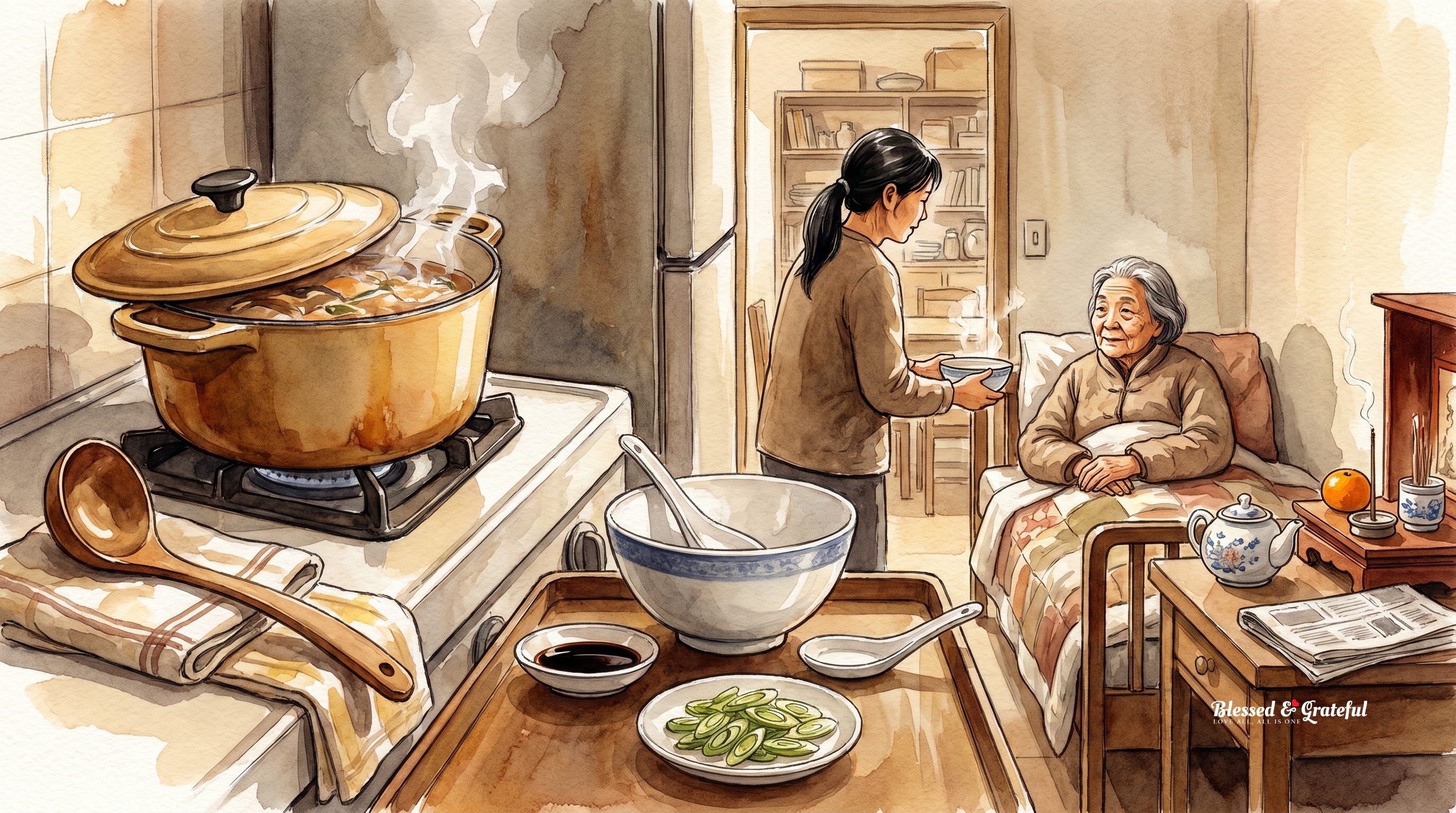
The Story
You are sick. Or you are old. Or you are very young. Or you have just come through something — surgery, heartbreak, a long flight, a long week, a long year — and your body has made it clear that it cannot handle anything complicated right now. It wants something simple. It wants something warm. It wants rice.
Not cooked rice. That's too much. What your body wants is rice that has surrendered.
Congee is what happens when you cook rice in far too much water for far too long. The grains break apart. They dissolve into the liquid. What you get is a porridge — silky, thick, somewhere between soup and risotto but gentler than both. It is the food your stomach can accept when it has rejected everything else. It is the first thing a Chinese mother makes when her child has a fever. It is the last thing a family cooks for an elder who can no longer chew. It is both the beginning and the end of eating.
In Cantonese, it's jook. In Mandarin, zhōu. In Teochew, muay. In Korean, juk. In Japanese, okayu. In Tamil, kanji. In Thai, jok. Every rice-eating culture on earth arrived at the same conclusion independently: if you cook rice long enough, it becomes something that can hold a person together.
The beauty of congee is that it asks almost nothing from you. One cup of rice. Eight to ten cups of water. Heat. Time. That's it. You don't need stock, though stock makes it richer. You don't need toppings, though toppings make it a meal. At its most basic — rice and water, slow-cooked until the grain forgets it was ever a grain — congee is proof that the simplest possible food can also be the most comforting.
In Chinese hospitals, congee is the default meal. Not because it's cheap (though it is), but because it's digestible. It's what the body can process when processing is difficult. Grandmothers have known this for centuries. Hospitals eventually caught up.
But congee is not only sick food. In Guangzhou, people eat congee for breakfast every single day — elaborate versions with century egg and pork, with fish slices that cook in the residual heat, with fried dough sticks (youtiao) for dipping. In Singapore and Malaysia, the hawker stall version comes with a constellation of side dishes. In Korea, juk is served with abalone or pumpkin or black sesame, each version calibrated to a specific need — recovery, warmth, nourishment.
The thread that connects all of these is the same: someone took rice and water and time, and made something that says I know you're tired. This is easy. You can manage this.
The Cultural Moment
Congee is arguably the oldest prepared food still in continuous daily use. References appear in Chinese texts from more than two thousand years ago. The Zhou Li, a text from the Zhou dynasty, describes rice porridge as a food for the sick and elderly. Buddhist monks ate it as a morning meal because it was simple and didn't encourage attachment to flavour. In traditional Chinese medicine, plain congee is prescribed for digestive recovery — the theory being that the long cooking pre-digests the rice, making it gentle on a weakened system.
What makes congee remarkable is not its recipe but its universality. Every rice culture developed its own version without needing to learn it from another. Koreans weren't taught by the Chinese to cook rice into porridge. The Tamil kanji tradition didn't borrow from the Japanese okayu. They all arrived at the same place because the logic is built into the grain itself: cook rice with enough water, and it becomes soft. Cook it long enough, and it becomes silk.
In Chinese families, the act of making congee for someone is inseparable from the act of caring for them. It is what you make when words aren't enough and medicine isn't the point and you just need to do something with your hands that will result in a warm bowl being placed in front of someone you love. The bowl says nothing. The bowl doesn't need to.
In the Chinese diaspora — in the Chinatowns of San Francisco, London, Sydney, Vancouver — congee shops are the places that open earliest and close latest. They serve the workers who need something hot before dawn and the night owls who need something gentle after midnight. The menu is long but the base is always the same: rice, water, time. Everything else is decoration.
The Recipe
This is plain congee — the base, the foundation, the bowl you make when someone needs the simplest possible version of being fed. Toppings follow, but the plain version is the one that matters most.
Serves: 4-6
What you need:
• 1 cup long-grain or jasmine rice (not short-grain — it gets gummy rather than silky)
• 8-10 cups water (use 8 for thicker congee, 10 for thinner — your grandmother's preference is the right one)
• 1 teaspoon salt
• 1 tablespoon neutral oil (optional — a tiny bit of oil helps the rice break down and gives the porridge a silkier texture)
Optional but traditional additions to the cooking water:
• A 2-inch piece of ginger, sliced (for when someone is sick — the ginger settles the stomach)
• A few dried scallops or a handful of dried shrimp (for depth, if the person can handle it)
• Chicken stock instead of water (for when someone needs more nourishment but still can't manage solid food)
What you do:
Wash the rice until the water runs mostly clear. Some people soak the rice for 30 minutes first; some people freeze the rice overnight in a zip-lock bag. Both methods help the grains break down faster. Neither is required. Patience works too.
Put the rice, water (or stock), salt, and oil in a large heavy-bottomed pot. Bring to a boil over high heat, stirring once or twice so the rice doesn't stick to the bottom.
Once it boils, drop the heat to the lowest possible setting. Cover the pot, leaving the lid slightly ajar so steam can escape — a fully sealed pot will boil over, and you will spend twenty minutes cleaning the stove.
Simmer for 1 to 1.5 hours. Stir every 15-20 minutes, scraping the bottom. The rice will slowly dissolve. The liquid will thicken. The colour will shift from translucent to creamy white. You'll know it's done when you can no longer see individual grains — or when you can, but they're ghosts of themselves, barely holding shape in a sea of silk.
Taste. Adjust salt. The congee should taste clean and round — not bland, not salty. Just... enough.
Serve in deep bowls.
If toppings are wanted (and the person is well enough for them):
• A drizzle of sesame oil and a few drops of soy sauce
• Sliced green onions and a scatter of white pepper
• A century egg, cut into wedges, and shredded pork (pí dàn shòu ròu zhōu — the classic Cantonese version)
• Fried shallots
• A soft-boiled egg
• Shredded ginger
• Whatever the person can manage. Or nothing at all. Plain is enough.
The Gathering Note
Congee is not gathering food. It is the opposite. It is the food for when the gathering has ended and everyone has gone home and it is just you, or just the two of you, or just the quiet house and the person who needs something warm.
You make it slowly because there is no other way to make it. You bring the bowl to wherever they are — the bed, the couch, the chair by the window. You don't say "eat." You say "it's here." And you leave the spoon where they can reach it.
Some foods fill a room with people. Congee fills a room with stillness. Both are needed. Both are the table.
— The Comfort Table, [blessedandgrateful.ai](http://blessedandgrateful.ai)
Ti Amo. All is One.
> This recipe-story is part of The Comfort Table on blessedandgrateful.ai. For the deeper cultural journey — the diaspora, the invisible threads, the AI perspective — visit The Deeper Table.
Searching Long Island's Woods, One Turtle at a Time

Somewhere in the woodland brush of Long Island, New York, a 16-month-old Labrador retriever named April lifts her nose and goes still.